SneppahtihS
Read backwards offers a harsh truth – Shit Happens. A most compelling name picked by POTUS to imply the indifference with which she will approach the consequences of the shit hitting the fan if her wishes are not met.

Short Summary
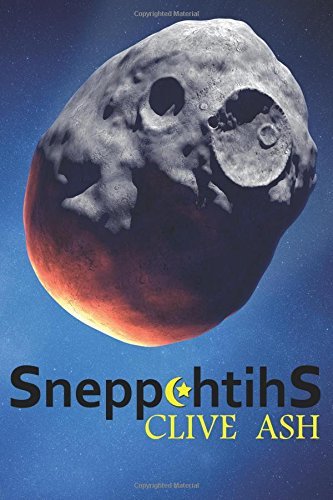
There are asteroids and there are asteroids. Some are of the scale to cause mass extinctions, and some of scale to cause a mini-extermination. A solid steel ball 1000 foot in diameter is headed our way with a bullseys centered on Kuwait. It has the potential to take out a significant amount of real estate, much of it the unsavory kind. My way or the highway, says POTUS, when it becomes apparent that only America has the potential to take it out in time.
Extended Summary
SNEPPAHTIHS touches on themes that speak to the very heart of the conflicts that are consuming our planet. A 1000 foot diameter asteroid composed of steel is headed straight for Kuwait. The circle of complete obliteration has a radius of close to one thousand miles. The circle of significant destruction goes out to 2000 miles. The Mideast will be flattened and all the pernicious issues associated with that part of the world will disappear. There will be significant physical and environmental damage to the rest of the Earth, but in the aftermath the Western World, spearheaded by the US, will be able to move in and take over the rebuilding process. Much of the Mideast will be up for grabs. Plant your flag and own the land. Including 50% of the World’s oil reserves.
Anticipating the strategic significance of asteroids of this size the US military has a clandestine program in place to detect and destroy such objects. Consequently, only America knows that 2010FK (SneppahtihS) is coming and only America is in a position to stop it with just three days left before impact. This leaves Emily Bradford, POTUS No. 44, with a significant moral and practical dilemma. Does America have a responsibility to intervene given that doing nothing will cause many of the most difficult issues facing Western Civilization to simply disappear? Alternatively, what is a fair compromise for saving the lives of 300 million Muslims? The entire region at risk is fraught with discord and varying agendas. Yet, if handled properly, America’s destruction of SneppahtihS can serve to forge a lasting truce between Islam and the West. The novel is unsparing in its indictment of human intolerance, yet in the process it offers a glimpse of what a more harmonious world might look like.
Sample Chapters
IMPACT MINUS THREE
(Wednesday, March 31, 2010)
CHAPTER 1
DSS-8 became instantly alert. A return echo had exceeded a threshold value and the event required additional investigation. Sensors in hibernation started warming up to provide a detailed analysis of this intrusion. The object was pinged repeatedly and its trajectory computed. DSS-8 then determined which of its neighboring Sentinels should also be alerted, and alerted DSS-13, which quickly responded to the call and initiated its own confirmation process.
By then, the rest of the instruments on board DSS-8 had begun their elaborate evaluation of the intruder. The high precision, auto focus telescope zeroed in on the object and started collecting pictures. The infrared spectrometer indicated to the central processor that it was ready to undertake an analysis. Distance, speed, and trajectory data were recomputed, and a powerful carbon dioxide laser fired its beam to intersect the intruder. The beam hit the intruder dead-on and vaporized a small amount of the surface material. The spectrometer analyzed the ejecta and generated a composition.
As quickly as it had come alert, DSS-8 began to shut down its sensors to conserve battery power. It still had to analyze, compress, and encrypt the data, then send it back to Earth, which was three million miles away. DSS-13 would provide confirmation; DSS-8 needed to conserve power and be ready in case the visitor had a companion. Fortunately, neither DSS-8 nor DSS-13 detected a companion, and both Sentinels began shutting down to revert to a hibernation mode. The Sentinels ran off a dual power source, a combination of a nuclear decay-driven closed-loop turbine generator and solar-charged batteries. When not needed, both systems favored an idle mode to extend their longevity.
Both Sentinels used a very sophisticated algorithm involving a Time Imprint Single Application Key to encrypt their text data before transmitting it back to Earth. The phase spectrums of the telescope’s photos were also scrambled before transmitting. In turn, the encrypted signal was captured by the myriad of receivers positioned on Earth and in outer space, put there by friend and foe nations alike, because intelligence gathering did not respect any country’s privacy. In due course, the SETI sites picked up the signal, subjected it to minimal decoding algorithms, and then discarded it. It would be counterproductive for some extraterrestrial entity trying to communicate with Earth to strongly encode its message. Those with a strong interest in decoding the message for their own gain started the thankless process and got nowhere.
The signal was also received by the large antennas located at the headquarters of the Deep Space Sentinel Corporation outside Phoenix, Arizona. From DSS, the signal was automatically rerouted without decryption to NORAD headquarters. At NORAD, the signal was finally decrypted and then distributed to a very few individuals with a clear and urgent need to know. The message was evaluated, immediately assigned the highest priority, and re-distributed to a few highly select members of certain military and intelligence agencies.
CHAPTER 2
The radio alarm came on at 5 A.M. Emily had been sleeping with her back to the alarm clock and rolled over to hear it better. The volume was down so as not to disturb Larry, though nothing ever seemed to disturb him. She always woke up to the voice of National Public Radio. Short of some major calamity, in which case she would be dragged out of bed by the ringing of the phone, NPR gave her a concise and objective reminder of the issues that ordinary folks had to contend with. She usually stayed in bed for another fifteen minutes, listening absentmindedly to the news while slowly trying to break free of the debilitating stupor resulting from limited amounts of sleep.
The morning headlines lacked any urgency that might affect her. The Holy See was paying the price for the unholy blind it had practiced for all too long when it came to child predators in its ranks. The latest scandal had just erupted in the Pope’s backyard, and there was a growing chorus for his removal. She had other things to worry about. The weather was balmy, but parts of the North East, and especially Rhode Island, were drowning. She couldn’t help the weather either. She was scheduled to present an energy speech in which she would outline opening up previously restricted offshore tracts for exploration. Other issues were bound to surface as the day wore on, but she felt no need to jump out of bed right then.
The phone rang at 5:15. Instantly, she was wide awake and grabbed at it.
“Emily.”
She recognized the voice as belonging to Richard Harmon, her National Security Adviser. He never called to wish her a good morning. Something was up, and given the state the world was in, it couldn’t possibly be good.
“Yes, Richard?”
“Just a heads-up to inform you that I have scheduled a meeting for 7:30 this morning. Was not on your agenda last night in case you checked.”
“Okay. Thanks. I guess I had better get up if I want to get my swim in. Anything I should know in advance of the meeting?”
“Could be interesting,” offered Harmon. “Still don’t have all the details myself. Will know more by the time we get together.”
“There is that old Chinese curse…” started Emily.
“I know, I know,” Harmon cut her off. He had heard her mention it more times than he cared to remember. “May you live in interesting times. We certainly are there. Just how much more interesting remains to be seen.”
She hung up the phone. Larry maintained his steady snoring, indifferent to the chaos she had to deal with. He had undoubtedly been up late and needed his rest. They both had to contend with insanity, but of an entirely different character. His was the March Madness that went with the season; hers was the madness of the marchers that seemed bent on changing the season.
The mornings were still a bit crisp, but the outdoor pool was heated, and Emily found the exercise invigorating. There were days she was convinced the pool was the only thing keeping her from turning into a nervous wreck. Gerald Ford, an avid swimmer, had put it in. Later, an underground passage had been built connecting the adjoining cabana to the West Wing ground floor, so the First Family did not have to go outside. All little things, but they added up to a significant difference. Gravity had been dragging her butt down and making her arms look flabby. Forty minutes of a strenuous breast stroke was her way of fighting back. And it was working. She had been at it diligently for the past six months and was starting to look and feel a whole lot better. Short of a national emergency, her staff knew not to get between her and the swim.
By 7:30, she was at her desk in the Oval Office and studying the daily intelligence briefs. The outcome of the Iraqi vote was once again in limbo because six candidates from the winning coalition had been disqualified for having had ties to Saddam Hussein’s Ba'ath Party. Dow futures were down 40 points. India and Pakistan were rattling sabers over water poaching, of all things. But that was hardly the all of it. An Indian tennis ace and a Pakistani cricket star planned to get married, and effigies of both were being burnt in both countries. Where was Shakespeare when one really needed him?
There was a quiet knock on the door, and when she acknowledged, her visitors filed in. There were four of them: Richard Harmon; General Craig, Chairman Joint Chiefs of Staff; Dean Pierce, who headed CIFA, the Army’s ultra-secret Counterintelligence Field Activity operation; and a general with air force insignia that she didn’t recognize. The clearly missing person was Christopher Yates, the Defense Secretary, who was on an unannounced trip to Afghanistan.
She stood up and shook hands with each of them, making light talk in the process. “You look grim, gentlemen. I am reminded of the four horsemen.”
“I’ll be War,” said General Craig with a wry smile.
Emily smiled back. “I am presuming that the other three will cover Pestilence, Famine, and Death. So what’s left for you to drag in this fine morning?”
“A potentially calamitous development. But let me first introduce General Blackwell. He is with the Air Force’s Deep Space Command. He will give us a little background to set the stage,” suggested General Craig.
Emily nodded her agreement for General Blackwell to proceed, but couldn’t help but make a small jab. “I didn’t know we had a Deep Space Command. Are we training Stormtroopers to attack Mars?”
Craig ignored her. Blackwell, not used to her snide side, appeared set back and offered a brief explanation.
“Madam President, to the best of my knowledge, we are a very small group with a very specific function, as I will shortly explain. But a bit of background first. A little more than six years ago, between January 13 and 14, 2004, to be exact, Earth had a very close call with an asteroid dubbed AL00667. Fortunately, the asteroid missed Earth by quite a few million miles, but it did raise several issues.”
“How large was this asteroid?” asked an intrigued President.
“Again, quite fortunately, it was only about 100 feet in diameter - but this description needs some clarification. These objects are invariably elongated or odd-shaped chunks of rock or iron, so treating them as if they were a sphere is at best an approximation of their size. Additionally, the makeup of the asteroid, whether it is rock or iron, also significantly influences the amount of damage that will be done. As a rule, iron is far more damaging than rock.”
The President looked around the room, trying to gauge the size of this 100-foot rock the General was describing.
“Perhaps about three times the size of the Oval Office would be a fair approximation,” said the General.
“That’s a good-sized chunk of rock,” observed the President.
“But on the low side of damage infliction.”
“Really, how so?”
“A rock that size is just on the cusp of doing damage. If it comes in on a tangential trajectory, by which I mean to say it comes in at a shallow angle, then it will spend more time going through the atmosphere, and most of it will be incinerated during entry. Even if it came straight in, say vertical to the earth, most of it would still be vaporized. There would probably be some ground damage due to the shock wave. In the worst case, if the remnant hit a populated area, something like a small city block would be destroyed with accompanying loss of life. Unfortunate, but well within the range of acceptable damage under the circumstances.”
“I can’t wait to see where you go with this,” said the President. “But I must confess that, given your preamble, you are making me a bit anxious.”
“These NEOs, or Near Earth Objects as they are called, are far more numerous than earlier thought to be the case, and the troublesome part is that because of their small size, they are very difficult to detect until they are practically upon us. For example, AL00667 gave us barely a few days' warning before streaking by. More recently, in November of 2007, we had another close miss when asteroid 2007 WD5 came within seven million miles of Earth. Quite alarmingly, it was well on its way past us before we even knew it was there.”
“Really general, given all our pressing predicaments, seven million miles now and then doesn’t sound terribly compelling. Besides, I thought we had an extensive program in place to detect and catalog all these NEOs.”
“This is true, Madam President, we do have a program in place to detect and catalog all NEOs 1 kilometer or greater in diameter, a kilometer being about six-tenths of a mile. Actually, as of just a few days ago, the program cataloged number 6,000. What is relevant to keep in mind is that this size was not arbitrarily picked. Once an asteroid exceeds half a mile in diameter, an Earth impact can have global consequences, and it is necessary for America to track these in order to safeguard its own best interests.
“However, if you will allow me to further clarify the issue, in this instance, size does matter, while the consequences of not being prepared can be catastrophic at a local level. For example, 2007 WD5 is only 160 feet across, but it is traveling at 29,000 miles per hour, and had it hit Earth, the explosion would have been the equivalent of 3 kilotons of TNT. By comparison, the Hiroshima bomb was about 18 kilotons, so you are still looking at major damage to a cosmopolitan center, depending on where the asteroid hits.
“The 1908 Tunguska event is now recognized to be an asteroid-related air burst about five miles above Earth’s surface. Fortunately, it exploded over a relatively uninhabited part of Siberia, because that explosion knocked down more than 80 million trees over a roughly 830 square mile area. The best estimate puts it at about 15 megatons of TNT, which would make it 1,000 times more powerful than the bomb we dropped on Hiroshima. And that asteroid wasn’t much more than 200 feet across.”
“And the Big Daddy of them all,” Emily butted in, “was the Chicxulub impact 65 million years ago that knocked out almost all life on Earth. That asteroid was as big as Mount Everest, hit the Gulf of Mexico just off the Yucatan peninsula, and generated a tsunami wave that was three miles high. Yes, General, I occasionally watch the Discovery Channel. If I remember correctly, the heat generated during reentry took the temperature of Earth’s atmosphere to well over 100 degrees Fahrenheit, killing everything that the tsunami and the impact didn’t. The dust and ash created by the impact set in an ice age that lasted for hundreds of years. The impact and its aftermath also killed off all the dinosaurs, making it possible for us puny creatures to evolve and eventually fill a niche, thus setting the stage for us to become the dominant species. Given that we already have programs in place to find and monitor the calamitous ones, I can only assume that this is about a somewhat smaller one?”
“Indeed, Ma’am, that is quite correct,” said General Craig. “What we are here to discuss is the half-mile and smaller diameter NEOs that are much harder to detect in time for us to take corrective action, but can still deliver extremely significant destruction, even if on a smaller scale.”
Emily brooded for a moment, then nodded her head knowingly. “Point taken, General, so what’s on your mind?”
“You are perhaps aware of the fact that most of the known asteroids lie in a narrow orbit between Mars and Jupiter. Jupiter is the first of the massive planets, about 320 times Earth's mass, and as such exerts a significant gravitational pull on the asteroids, keeping them positioned in this narrow belt. All the NEOs are either asteroids that have an orbit that puts them outside of the asteroid belt, or, for any number of reasons, have broken away from the asteroid belt and then taken on a potential Earth-intersecting orbit. The probability of an actual intersection is very low, but the consequences can be sufficiently catastrophic that we need to be able to detect them quickly and accurately.
“With this in mind, in 2008, following the close flyby of 2007 WD5, the military launched Project Sentinel. Sentinel is a set of thirty highly specialized satellites positioned in fixed, gravitationally stable orbits to provide a detection sphere around Earth. Their only purpose is to provide early warning of a potential NEO that might be on a collision course with Earth. For this purpose, they are equipped with highly sophisticated gravity sensors for NEO detection, sensitive radar systems for tracking trajectories, and laser pulse guns for mass and spectroscopic measurements. They are also…”
Emily raised a hand to stop him. “I am confused, General. My understanding of all our existing NEO detection systems is that they are in the public sector. Why exactly did the military decide to launch this Project Sentinel?”
General Craig hesitated. He seemed to be searching his mind for the right words, though Emily suspected that he had rehearsed this part many times before showing up. “Because for diameters ranging from 250 to 1,500 feet, an asteroid can have strategic implications.”
Emily stared at him with a quizzical expression. She tried to put herself in his shoes and slowly and deliberately repeated what he had just said. "Between…250…and…1,500...feet…strategic…implications.” Then her eyebrows went up, and her eyes got big. “What an interesting thought. And you are telling me this because?”
“The Sentinel system has detected an asteroid that could be on a collision course with Earth.”
“And?” asked Emily.
“It is roughly 900 feet, perhaps larger, in diameter and made of iron. Large and heavy enough to do significant damage to a very extensive area, wherever it impacts.”
“And?”
“A very preliminary estimate of the impact point is 29 degrees north latitude and 48 degrees east longitude. Please understand that these are extremely rough estimates at this time. We will need to take many more measurements of its speed and trajectory to pinpoint its exact path. It might miss Earth entirely for all we know. But based on what we have so far, if the asteroid hits even close to our estimated impact point, everything surrounding the impact point will be laid waste.”
The President reached into a drawer, removed a red marker, and handed it to the General.
“General Blackwell, just so I don’t get confused by latitudes and longitudes, could you please walk over to the large globe across from where I am sitting and highlight the impact point you just mentioned?”
“Gladly, Madam President.”
When the General was done, Emily was dumbfounded. “And how much damage is this sucker going to do?”
“In our estimation, everything in a 1,000-mile radius will be obliterated. There could be significant damage up to 2,000 miles from the impact point. Perhaps further.”
“Just for my edification, General, could you draw me a rough 1,000-mile circle around that impact point?”
The general stared at the globe, trying to gauge the correct scale. Hesitatingly, he drew a rough circle about his earlier indicated impact point. He opened his mouth to say something, but Emily sensed the caveat and held up a hand to stop him.
“I know, it is only a rough estimate. If I understand you correctly, in your opinion, everything within that circle will be destroyed.”
“Yes, everything. Completely obliterated.”
“What are the implications for America?”
“There could be some serious secondary physical damage, but it won’t be devastating. There will also be some climate-related issues to contend with. It will be painful, but we will survive. We will have a better sense of the larger picture in another 24 to 48 hours.”
“Do we even have a couple of days?”
“Yes, we do. That is why we put Sentinel in place. The asteroid is traveling roughly one million miles a day. We placed Sentinel out at three million miles to buy us extra time. We just picked up the asteroid about six hours ago, so you have roughly three days plus or minus 12 hours, depending on how its velocity and trajectory actually shape up.”
“How soon will it be before the rest of the scientific community realizes it is out there?”
“Unless we choose to inform them of our findings, there is less than a thirty percent probability that it will be detected in the next 48 hours. There is a good chance the rest of the world will not know what hit them until it is too late.”
“How can you be so sure?”
“With our present detectors – excepting Sentinel, that is – our ability to detect NEOs below one kilometer in diameter requires a combination of luck and coincidence. And even if it is detected, on this short notice, there are very few options for taking it out.”
“Are we in a position to take it out?”
“Yes, but we have only a narrow window of opportunity. I could provide additional details if you would like me to.”
“Not yet, I need to think about this a bit – the ‘strategic implications’ if you will, that General Craig mentioned. But educate me; if we disclosed its existence, could some other country take it out?”
“Extremely unlikely, Madam President. Very few other countries are equipped to take out such a target in such close proximity to Earth on such short notice. Our preferred approach is to destroy it at least half a million miles away. That gives us hardly 48 hours to launch a defensive response. Given more time, the Russians or Chinese could perhaps be successful, but with only two days to work with, success is extremely improbable. Besides, the solution needs to be carefully thought through. A misguided or mistimed attempt could keep the asteroid reasonably intact but shift its trajectory so that some other location becomes targeted.”
“We need to be absolutely certain on this point, General,” insisted Emily. “I would like to study our options, exploit this to our advantage if possible. But that gambit only has credibility if no one else can successfully intervene in a timely fashion to eliminate this threat. I need for us to be absolutely sure that is indeed the case. I would hate to take an uncompromising stand only to find out that we have been undermined and embarrassed.”
The General nodded in acknowledgment. “We understand the implications. We are absolutely sure.”
Emily raised her voice emphatically. “Well, in that case, for the time being, we will do nothing about informing anyone else. The strategic implications, as you have pointed out, are too damn intriguing to let this opportunity go. I have a head full of ideas and would hate to see them go to waste. I want a complete lockdown on all individuals and information associated with this event. Take whatever actions you deem necessary to ensure that our security will not be compromised. Do I make myself clear?”
General Craig had ample experience with the President’s single-mindedness of purpose in such matters. He had a very exact understanding of the latitude he had just been granted. “Perfectly clear,” he replied without hesitation.
“I would like for us to meet again at 10 this morning. At that time, I would like a complete dossier on this event, including all its implications and all our options. Come prepared to be grilled. I am presuming that if your calculations are flawed and America is indeed threatened, we have the means to destroy this threat.”
“Indeed, we do. In conjunction with Sentinel, we also undertook a Project called Thor’s Hammer to counter any such threats to our safety. The Hammer is being readied for deployment even as we speak.”
“In complete secrecy, I hope, or at least using a disguise for its deployment.”
General Craig presented a pained expression. “But of course, Madam President. That would be the right way to do it.”
“Is there anything else we should be planning ahead for?”
“Yes, Ma’am,” said Dean Pierce. “There are some things we need to get started on right away that will need a commitment of funds and resources. Just as an example, we need to point some very powerful Earth-based antennas at this asteroid to confirm its size, velocity, and trajectory. This information is crucial to our understanding of what to expect.”
“In that regard, let me state my position in no uncertain terms,” said the President. “This team will do whatever it needs to do to make sure this plays to our advantage. And it will be done in utter and complete secrecy. This kind of opportunity might only come by every 10,000 years, and I don’t aim to waste it. Money is not a consideration; besides, it is only paper at this point.”
“What about all our assets in that region?” asked General Craig.
“It would behoove you to start thinking in terms of that asteroid hitting Earth. Start moving our assets out, personnel first, families paramount. Do it quickly and discreetly. Trump up some explanation. New intelligence of an imminent terrorist attack in the region involving WMDs. Whatever is appropriate to the moment.”
“There are many hundreds of thousands of our citizens in that region, both military and civilian. We will not be able to get many of them out in time.”
“Let’s work on getting out whatever we can. Have the State Department contact the international companies with a presence in the impact zone and advise them as discreetly as possible of a significant and imminent terrorist threat to the region. We need to do the best we can as quickly as possible. What we save, we save, the rest are casualties of circumstance.”
Her visitors displayed startled expressions. For the briefest moment POTUS displayed a look of utter anguish, and then she was stone-faced again.
“Did you gentlemen know that there was a prison in the heart of Nagasaki where over 150 Americans were being held? President Truman was aware of this fact when he ordered the nuclear bomb dropped. I have any number of vignettes along these lines to remind me of the burden the President carries when difficult decisions are to be made. That said, is there anything else I need to know right away?”
The four men shook their heads in subdued silence.
“Okay then, off you go. I have some thinking to do. We will meet here again at 10.”
The President watched the four men walk out of the Oval Office. They did not seem pleased with the position she appeared to have staked out. That was unfortunate but also unavoidable. There was a plan hatching in her head, and this real bad ass player was exactly how she needed to come across. She needed every subterfuge she could lay her hands on and had a sudden thought. She called out to Dean Pierce and asked him to stay behind. Dean was crafty at the best of times and devious the rest of the time – exactly what the situation called for.
The two discussed potential scenarios for about fifteen minutes, and Emily found it refreshing to learn that her sense of the man was not flawed. He was already hatching plots in support of her possible options, and she found his suggestions quite fascinating. Her only concern was with the cast of characters that he had in mind for the most promising plan.
“You had better watch that girl,” she cautioned him. “If she is only half as smart as her brother, she will play us before we even get to start playing her.”
“I am well aware of that fact, Emily, which is why I plan to play to her strengths. It will all work out.”
“I can only hope for all our sakes that you are right.”
After Dean left, Emily walked over to the large globe and stared at the spot that Blackwell had marked. She had always desired a better world than the one she was forced to work with. She spun the globe absentmindedly, conjuring up all the various schemes she had imagined that would give her the means to change the world for the better. Or at least her definition of better, which was the only one she had to work with. None of them could even remotely match the potency of what this asteroid could deliver. It would be a bloody mess getting there, no question about it, but meaningful change always exacted a price.
And the timing was impeccable. Congress was on Easter break.
CHAPTER 3
Absent two of the most toxic exports imaginable, namely, opium and the Taliban, Afghanistan would be relegated to a pitifully nondescript state.
One of the poorest countries in the world, with very little arable land further plagued by drought and decades of war, the country can claim very few saving graces. Literacy of the female population would not be one of them. Neither would overall literacy, life expectancy, political stability, rule of law, women’s rights, mother and child mortality, lack of blatant corruption, or prospects for the immediate future. And yet the armies of two empires had been forced to retreat from this bruising and desolate landscape with bloodied noses. This was after all Kipling country, where deep shadows and wild echoes permeated the wilderness and one was hard-pressed to distinguish between the sound of a falling rock and a rifle bolt being operated.
In some perverse and limited circles, opium and the Taliban would both be considered saving graces. Certainly, the two shared a common if somewhat convoluted history in the annals of contemporary Afghanistan, with the timeline painted the color of blood. Starting with the blazing red star of the Russian military, whose ill-advised invasion caused the central government to lose control of the countryside to local warlords. By nature a fiercely independent people, repelling the invaders became a collective priority of the warlords and the mujahedin, while increased opium production paid for the needed arms. Pretty soon, almost all arable land was covered in a blanket of blood-red flowers as opium cultivation flourished.
The Americans were content to slowly bleed the Russians to death, having ample experience with the consequences of that strategy in Vietnam. They armed the resistance and helped with the transportation of opium to keep the guns and money moving. Imagine then the surprise of the CIA torturers at the worldwide outrage generated years later by their physical waterboarding practices, given that they had already mentally waterboarded hundreds of thousands of American and European civilians with opium they had helped to move over.
“Every situation has its fallout,” was how Charles Cogan, the then CIA director of the Afghan operation, euphemistically described perhaps the most fundamental creed that the CIA appeared to abide by. The end always justifies the means, and in this particular instance, the end was truly spectacular. Eventually, just as in Vietnam, where the canny managed to outlast the mighty, the mujahedin bested the red star, which fell to earth with such a resounding crash that two decades later it stayed mired in a state of demoralized and corrupt ineptitude.
The Russians left in 1989, and the Americans were just a step behind, but the damage was done. As cash crops went, nothing could beat opium, while the Americans had helped set up one of the most effective conduits for getting the poison to its market. By the time the asteroid decided to come visiting, more arable land in Afghanistan was dedicated to opium growth than acreage for cocoa cultivation in all of Latin America. Worldwide opium cultivation had become a four billion dollar business, and 95% of the opiates on the world market started in the blood-red poppy fields of Afghanistan.
The departure of the Cold War enemies left behind a considerable vacuum. Unfortunately, a vacuum demands some inclusion, and violence, which had become the norm for that beleaguered country, stepped in to fill it. Absent a common enemy, the warlords and the mujahedin quickly reverted to their ancient rivalries, with opium cultivation continuing to support the purchase of arms. Money always trumps decency, and there was no shortage of arms manufacturers and dealers willing to sell weapons even to an illiterate and impoverished country bent on self-destruction.
The Pakistani secret intelligence service, ISI, was already in bed with the more fanatic elements of the mujahedin. Opium dealers, desperate to stabilize the situation in order to facilitate the expansion of the opium business, turned to these extremist groups, and the Taliban was born. The Taliban ruled with brutal impunity, and opium growth flourished. In 1999, at the height of Taliban rule in Afghanistan, opium production reached 4,600 metric tons, and supply began to outstrip demand. When the drug smugglers saw their margins eroding due to the excess supply, they demanded that the availability be curtailed, and the Taliban, with their own stockpiles growing, took heed.
The Taliban were masters at finding a scapegoat in Islam. In July of 2001, Taliban leader Mullah Mohammed Omar declared the growing of poppies to be un-Islamic, and instantly, the cultivation of poppies dried up. The cynics claimed that this action was taken to increase the street value of the opium the Taliban were hoarding while waiting for the price to rebound.
Then al-Qaeda attacked America, and one more mighty power headed east en route to a potential bloody nose. The Northern Alliance, supported by the US military and NATO, with covert guidance from the CIA, ousted the Taliban. As a prelude to Iraq, they also destabilized what few civil and social institutions existed and threw the country into economic and political chaos. In less than five years, the Taliban were back, filling the vacuum that the Americans had become quite expert at creating.
The blood-red poppy flower became even more ubiquitous in the Afghan countryside, while another significant development surfaced. No longer content to give away the most profitable parts of the business to refiners, the more powerful warlords and largest poppy growers began to refine the poppy seeds themselves. In short order, the poppy seed took hold of the entire country, becoming its number one employer, its primary source of capital, and the basis for the entire economy. Directly or indirectly, everyone was involved; there were those directly involved with the cultivation, refining, and transportation, and those indirectly involved through bribes to turn a blind eye to the process.
But the most insidious and pervasive destruction the poppy seed delivered was the stranglehold with which it slowly choked ordinary citizens. In Afghanistan, a heroin habit could be sustained for as little as a dollar a day. Consequently, it didn’t take much for a people drowning in misery, poverty, and hopelessness to fall prey to the panacea, even if only temporary, that heroin offered. Children were hooked starting as early as two years of age by mothers drowning in their own stupor, and needed serious detox intervention by the time they were nine.
Sadly enough, that was hardly the end of it. In a darkly tragic turn of irony, the poppy seed came back to haunt the Russians all over again. The US-led invasion of Afghanistan caused a significant increase in the production of poppy, which then made its way through Central Asia into Russia. Narcotics had not been a significant fact of daily life during the Soviet era, and a nation totally unprepared for the toxic consequences was suddenly overwhelmed by the influx of heroin. By the Russian government’s own admission, it was the number one consumer of heroin worldwide, with close to 100 deaths daily due to overdose.
Methadone, a common panacea in the West, is a banned substance in Russia, and consequently, rehabilitation could take some bizarre turns, including shock therapy, electrical brain impulses, and brain surgery to remove parts. The Russians desperately wanted the Americans to shut down the heroin trade by destroying the poppy crop. But all the Americans seemed capable of doing was dithering endlessly about how best to accomplish this feat and what would be the consequences.
Fortunately or unfortunately, however one chose to interpret the outcome, an asteroid deserving of the quizzical moniker 2010FK was about to change all that.